There comes a point for a lot of businesses when you look at your logo, website or marketing materials and think, Is this still working for us?
Maybe the logo feels a little dated. Your website no longer reflects the quality of your business. Your marketing materials have slowly become a collection of different fonts, colours and styles. Or maybe the business itself has simply evolved, while the branding hasn't quite kept up. Different departments, employees or outside partners may be creating things independently, and suddenly the brand looks a little different everywhere it shows up.
The immediate assumption is often that something needs to change. Maybe it's even time for a complete rebrand. But starting over isn't always the answer.
Sometimes a business needs an entirely new identity. Other times, there's plenty worth keeping and a thoughtful brand refresh can make a surprisingly big difference.
So, how do you know which one you need?
What's the difference between a brand refresh and a rebrand?
A brand refresh works with the recognition and brand equity you've already built.
That might mean refining your existing logo rather than replacing it, expanding your logo suite, updating your colour palette and typography, introducing new graphic elements, or creating clearer brand guidelines. Often, it also means bringing your website and other marketing materials in line with the refreshed identity.
The goal isn't to make your business look like something completely different. It's to make the brand you already have stronger, more cohesive and better suited to where your business is today.
A rebrand goes deeper.
Rather than asking, How can we improve what we already have?, a rebrand asks whether the existing identity is still the right identity at all.
That can involve a completely new logo and visual identity, but it may also include changes to brand positioning, messaging, personality and the overall direction of the business. In some cases, even the business name changes.
In short:
Brand refresh: Evolution.
Rebrand: Reinvention.
Neither is inherently better. It depends entirely on what's working, what's not, and where the business is headed.
Signs you may only need a brand refresh
If you've spent years building recognition around your business, throwing everything away for the sake of looking new can actually do more harm than good. Your existing logo may have built up years of recognition and brand equity, and changing it dramatically means potentially giving some of that up.
A refresh may be the better option if:
Your existing logo is recognizable, but feels dated or limiting.
You only have one logo and it doesn't work well across different applications.
Your colours, typography and graphics have become inconsistent.
Your website doesn't reflect the quality or professionalism of the business anymore.
Creating new marketing materials always feels like starting from scratch.
Your business has grown or evolved, but your visual identity hasn't evolved with it.
There are recognizable elements of your existing brand that customers already know and trust.
This is where restraint becomes important.
A good brand refresh isn't about changing things simply because you can. It's about identifying what's worth keeping and strengthening everything around it.
Signs it might be time for a full rebrand
Sometimes there's simply not enough worth preserving.
A full rebrand may make more sense if:
Your current identity no longer represents what the business does or who it serves.
Your audience or market position has changed substantially.
Your branding feels fundamentally disconnected from the personality of the business.
The existing logo is difficult to use or doesn't translate well across modern applications.
The business has changed ownership, direction or services significantly.
There's little meaningful recognition attached to the existing identity.
You've outgrown the brand to the point that refining it would only be disguising a bigger problem.
A rebrand gives you the opportunity to go back to the foundation and ask bigger questions about what the business stands for, who it needs to connect with, and how it should show up in the world.
What does a brand refresh actually look like?
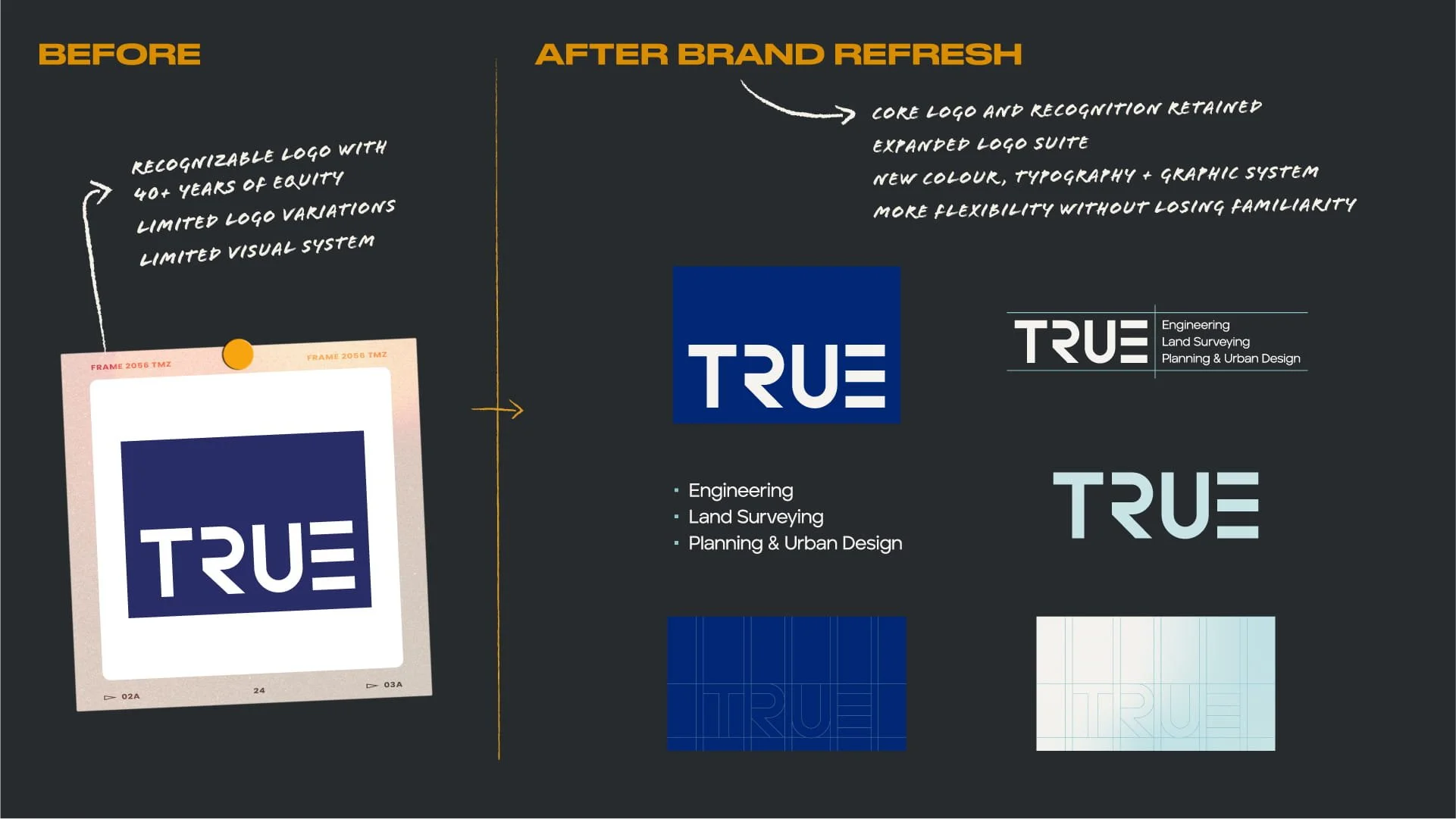
Two recent Badlands projects, TRUE Consulting and RYMAR Pro Builders, are good examples of businesses that didn't need to abandon their existing identities. Both had logos that had built recognition over time and were still worth keeping. What they needed was more flexibility, consistency and a stronger visual system around them.
TRUE had been operating for decades and had built significant recognition around its existing logo. Starting over simply for the sake of creating something new would have meant walking away from that history.
Instead, we refined what already worked.
The recognizable elements of the logo were retained, with subtle refinements, while the overall visual identity was expanded into a much more complete brand system. New typography, colours, logo variations and graphic elements gave TRUE more flexibility, while a new website and supporting materials brought everything together.
The result still feels like TRUE. It just gives the company a stronger visual system to work with as it continues to grow.
RYMAR Pro Builders was a similar case, but on a smaller scale. Their existing logo had recognition and still suited the business, but the identity needed refinement and more flexibility. The logo was cleaned up and expanded into additional variations, colours and typography were properly defined, and the refreshed identity carried into a new website.
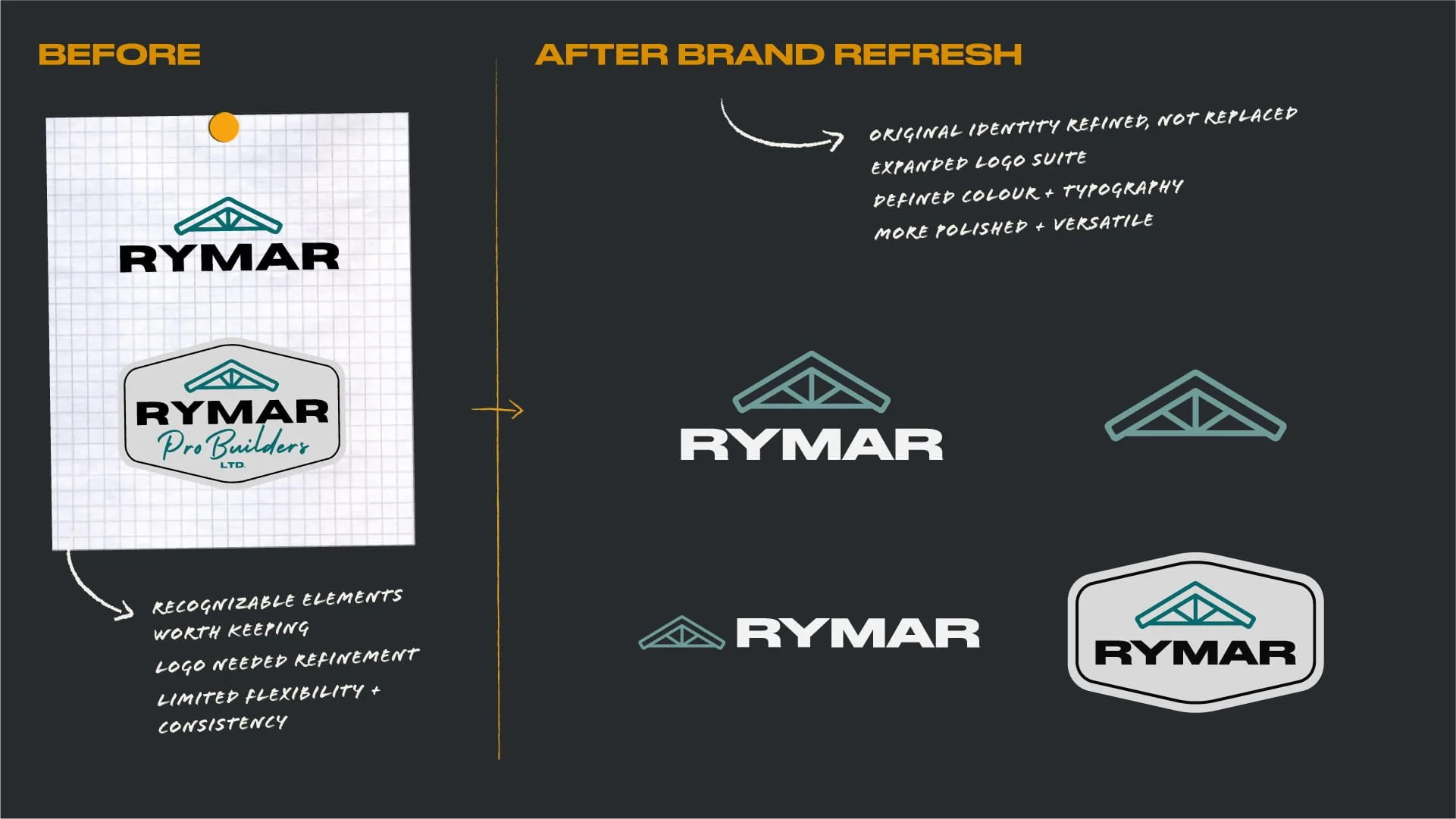
Neither project required changing everything. They required being selective about what should change and what shouldn't.
When starting over is the right move
On the other hand, sometimes the existing identity really is what's holding the business back.
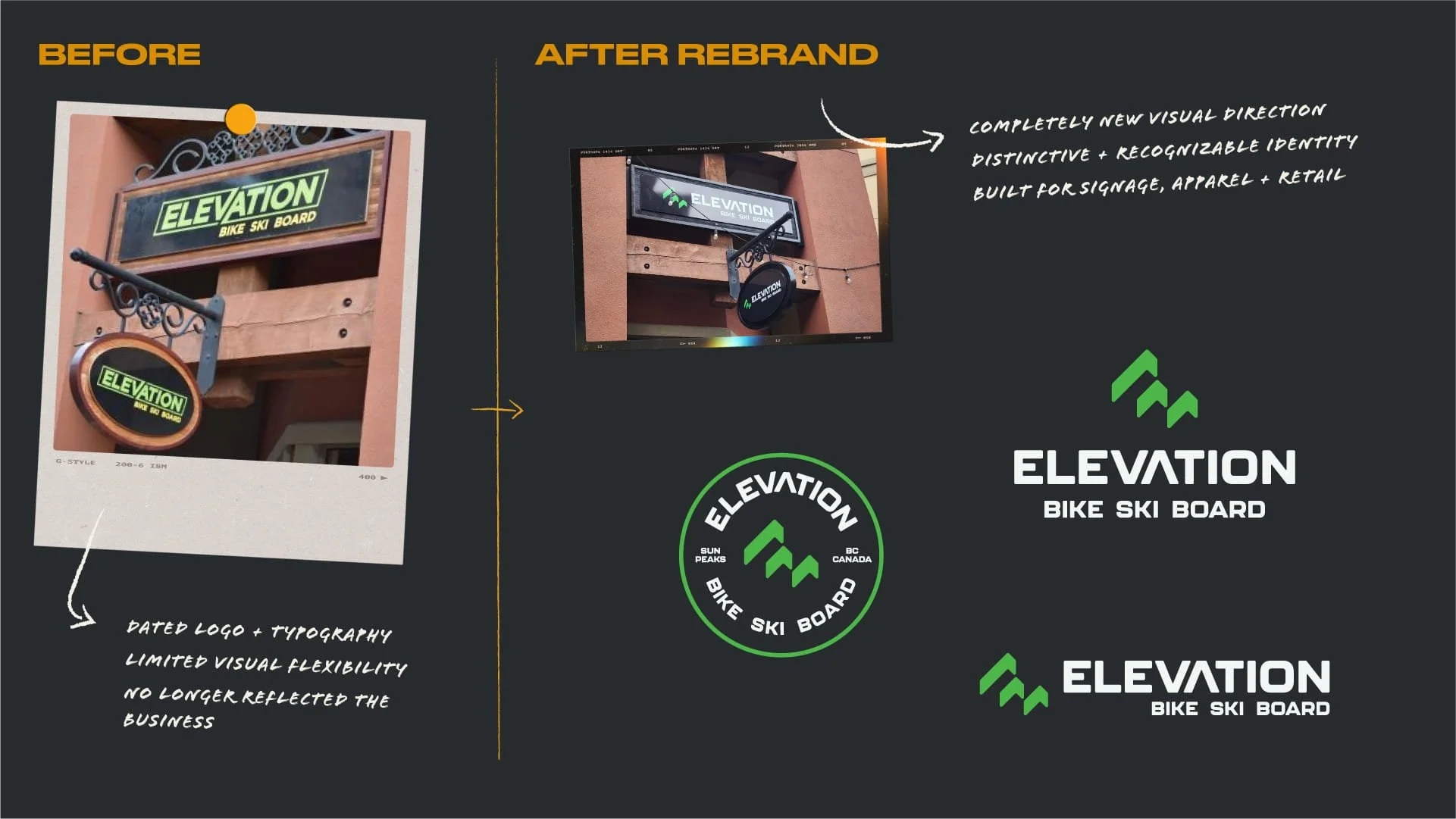
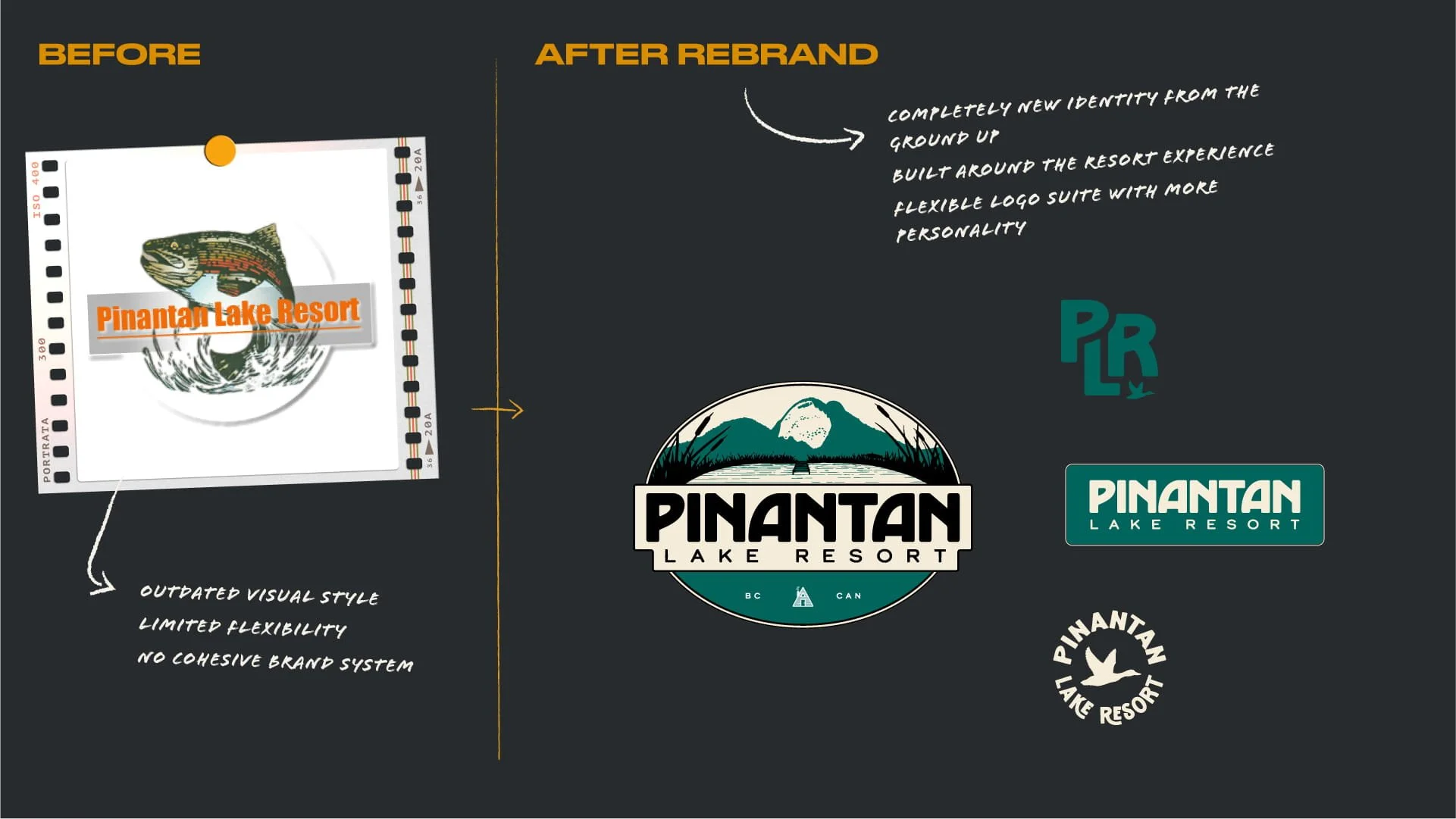
Both Elevation Bike, Ski & Board and Pinantan Lake Resort came to Badlands with outdated visual identities that no longer represented the businesses they had become. In these cases, simply refining the existing logos wouldn't have solved the larger problem.
When Badlands worked with Elevation, the project wasn't about polishing an established identity. It required developing a new brand from the ground up, with its own positioning, personality, visual direction and complete identity system.
Pinantan Lake Resort was another full rebrand. The existing branding no longer captured the character of the resort or the experience it offered. Rather than modernizing what was there, we developed a new identity that better represented the business and gave it a stronger foundation moving forward.
Those projects required a different kind of thinking because there wasn't an existing brand system we were trying to protect.
That's the fundamental difference.
A refresh asks:
What should we keep?
A rebrand asks:
What should this become?
So, does your business need a rebrand or a refresh?
If your branding is starting to feel tired, inconsistent or disconnected from the business you've become, don't assume you need to throw everything away.
Look at what still works.
Does your logo have recognition? Are there colours, symbols or other elements customers associate with you? Does the identity still represent the right business, even if the execution could be stronger?
If so, a strategic brand refresh may be enough.
But if the problem runs deeper, and the existing identity no longer represents your business, audience or direction, a full rebrand may give you the clean slate you need.
Sometimes the difference is obvious. Sometimes, it isn't.
Not sure which direction your brand needs?
Badlands Design Co. works with businesses in Kamloops and across Western Canada on both brand refreshes and complete rebrands, from refining an existing visual identity to developing an entirely new brand from the ground up.
If you've outgrown your current branding but aren't sure how much really needs to change, get in touch and we can talk through where your brand is now, what's worth keeping, and where it needs to go next.